This article, written by Mark Crites, a partner at Reagan Consulting, builds on a recent conversation featured in PIANJ’s Deep Dive discussion, in which Crites joined PIANJ for an in-depth exploration of the market forces shaping the insurance industry in 2026. During that discussion, he offered a wide-ranging and candid assessment of the challenges agents and brokers are facing—from slowing organic growth and shifting investor expectations to talent pressures and the accelerating role of technology.
What follows is just a small fraction of the insights Crites shared during that Deep Dive conversation. While the article highlights several key themes, the full discussion provided additional context, practical examples, and forward-looking perspectives that are well worth exploring. Members are encouraged to view the full Deep Dive discussion featuring Mark Crites.
2026 key industry trends
As we move into 2026, insurance agents and brokers are navigating a different market compared to the last several years. Growth is harder to come by, competition for talent is intensifying, and investors—both public and private—are sending clearer signals about what matters most.
Organic growth is challenged. As illustrated in the chart below, both private brokers and public brokers have seen steady declines in growth rates over the past few years. Rate increases and favorable market conditions that once fueled results are no longer providing the same lift.
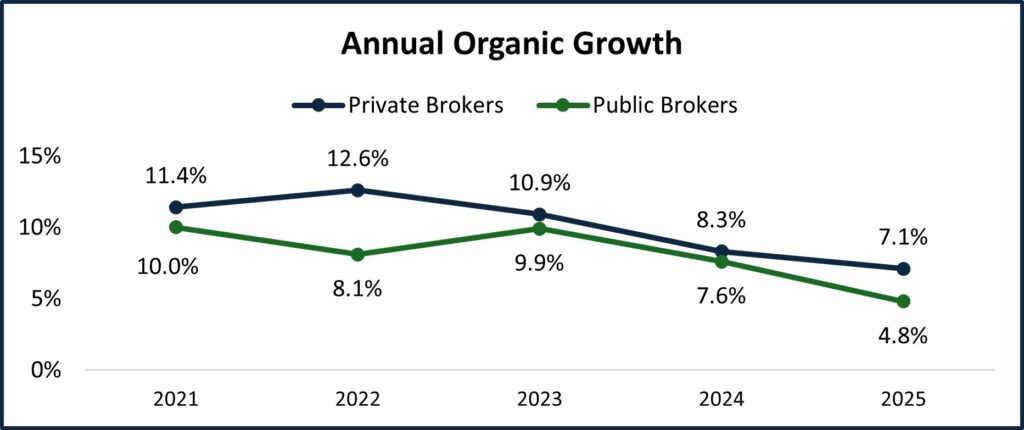
Sources: Reagan Growth & Profitability Study; Public Broker SEC Filings, market data (includes AON, AJG, BRO, MRSH, WTW).
This slowdown has primarily been driven by declining property/casualty premium growth from hard market highs experienced in 2021-22. While the broader economy has remained uneven but positive, declining prices have had a more significant impact on performance. The message is clear: future growth will rely far more on client new business production and retention, not market tailwinds.
Sales velocity matters more than ever. The organic growth equation for brokers only has four parts and two of those are in brokers’ control—new business (sales velocity) and retention (or the inverse of attrition). The other two, rate change and exposure change, are out of brokers’ control. With rate-driven growth fading, sales velocity—the measure of new business production—will become increasingly important and serve as a key differentiator over the coming years.

Sources: Reagan Consulting
Top-performing firms are separating themselves by how effectively they sell, specialize and retain clients.
Public markets are sending warning signals. Publicly traded brokers are experiencing growth pressures even more intensely than the private brokers. Public broker growth slowed to 4.8% on average during 2025. With lower growth performance and outlook for 2026, investors reacted harshly with a sell-off in 2025 following second quarter and third quarter earnings releases. This sell-off has led to the lowest valuation multiple for the public brokers since 2018.
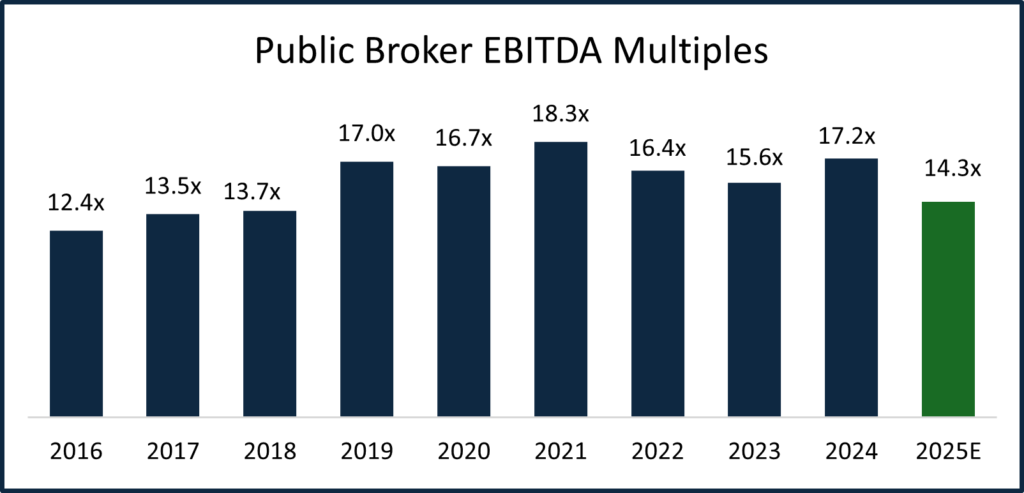
Sources: Reagan Growth & Profitability Study; Public Broker SEC Filings, market data (includes AON, AJG, BRO, MRSH, WTW).
2026 has not been kind thus far to the industry, following “Black Monday” on Feb. 9, 2026, when AI fears surrounded the industry. While the consensus thinks this was a massive overreaction, values have suffered as a result.
Private market valuations remain strong. Despite fewer transactions overall in 2025 (at least announced deals), the mergers and acquisitions market remains healthy. Pricing has remained strong, particularly for larger, high-quality firms with a positive growth story. The sheer number of active buyers will continue to be a key factor for strong activity in 2026.
Talent is the defining competitive issue. Perhaps the most urgent challenge facing agencies today is talent retention. National firms and private-equity-backed platforms continue to recruit aggressively, increasing pressure on independent agents and brokers. According to the 2025 Best Practices Study (conducted by Reagan Consulting, in partnership with the IIABA), 12.5% of employees at Best Practices firms are equity owners, but roughly 30% of employees are likely meaningful value creators to the firm’s overall success. This gap represents real retention risk.
To address this, many firms are expanding the use of equity-like or synthetic equity programs, which provide long-term incentives without diluting ownership. These programs, combined with enforceable contractual protections, are becoming increasingly important tools for retaining top performers.
Technology will separate the leaders. Finally, technology—especially artificial intelligence—continues to emerge as a competitive differentiator. Larger firms are investing more heavily in AI, and through a survey conducted with Broker Tech Ventures, 82% of producers under age 35 (for BTV firms) are already tech-enabled.
Bottom line
Agents and brokers who focus on sales effectiveness, broaden value-based rewards, invest thoughtfully in technology, and protect their talent will be best positioned to succeed in a more competitive 2026 and beyond.

Mark Crites
Mark Crites joined Reagan Consulting in 2017 and he is a partner in the firm. Mark primarily works with clients on mergers & acquisitions, agency valuation and strategic consulting projects. Prior to joining Reagan, Mark spent two years at the private equity firm, MSouth Equity Partners, acquiring middle market companies in the business services, media & telecom, specialty distribution, manufacturing and health care sectors. He was responsible for leading valuation exercises and executing due-diligence processes. He also worked closely with management teams on strategic planning and value-creation initiatives. Mark began his career in investment banking with Raymond James & Associates where he focused on sell-side M&A, and capital raising transactions for middle market companies. Mark is a Certified Valuation Analyst and a graduate of the University of Georgia Terry College of Business where he received his B.B.A. in Finance and Risk Management & Insurance. Currently, he maintains the Series 63 and 79 FINRA Registrations through Reagan Securities Inc., the affiliated FINRA-registered Broker/Dealer of Reagan Consulting Inc.